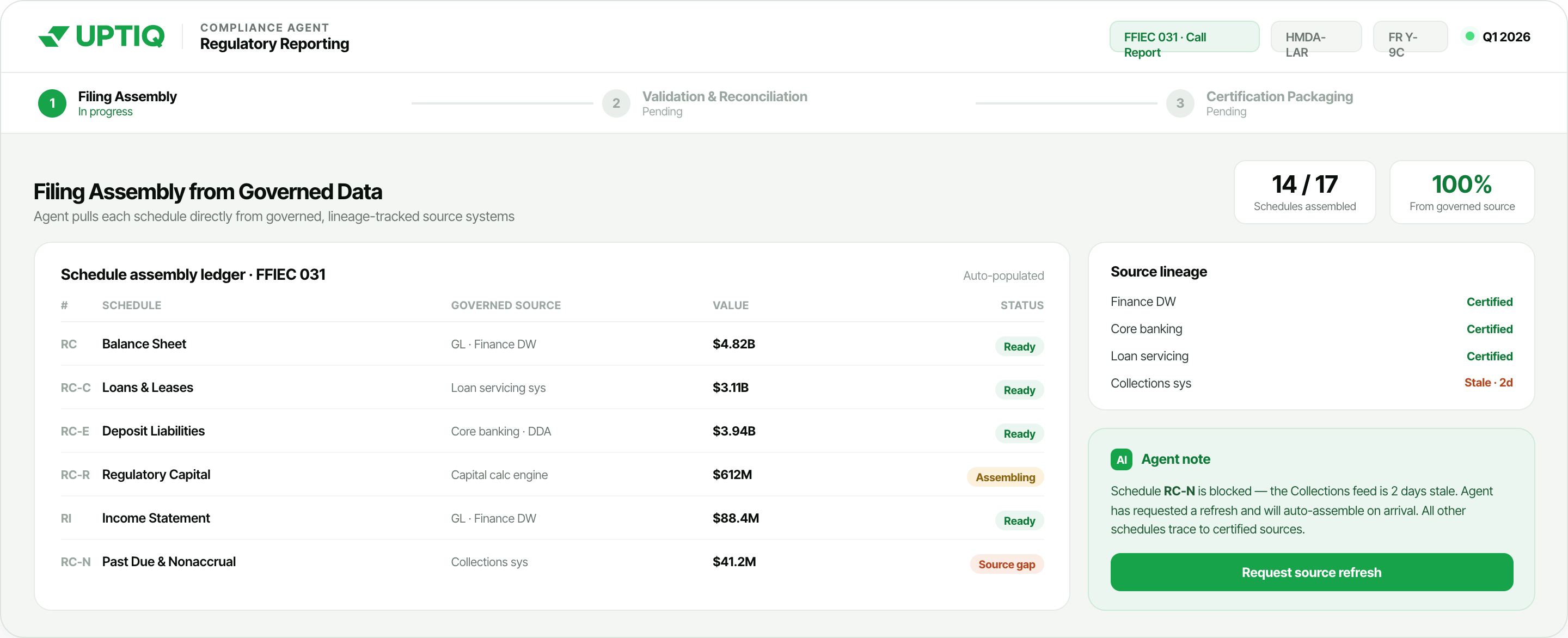
Assemble regulatory filings from governed data, validate every line against edit checks and source reconciliation, and package each submission for the human certifiers who hold the accountability — reducing errors, rework, and the preparation time that drains finance and compliance teams.


Replace the manual data pulls, calculation reviews, and last-minute reconciliation cycles that consume finance and compliance team capacity before every filing deadline with a structured preparation workflow that assembles, validates, and packages each submission, ready for the certifiers who sign it.


The Uptiq Regulatory Reporting Agent is an AI-powered solution that assembles regulatory filings from the institution's governed data, validates each filing against edit checks and source reconciliation, and packages the validated filing for the human certifiers who hold accountability for submission. The agent handles the preparation and validation work; certification and filing remain exclusively with the designated human accountable for the submission's accuracy under applicable regulatory requirements.
The result is a regulatory reporting process that is faster to prepare, more consistently validated before submission, and fully traceable from filed figures to source data, reducing the error rates, rework cycles, and preparation-time burden that characterize manual regulatory reporting processes at institutions that prepare multiple complex filings each quarter. By automating the preparation and validation steps, the agent allows finance and compliance staff to focus on reviewing and certifying rather than assembling and reconciling.
The agent currently supports five filing types that together represent the primary regulatory reporting obligations for US-chartered banks and credit unions: the Call Report (FFIEC 031/041/051 for banks) and NCUA 5300 (for credit unions) for consolidated financial data; the HMDA Loan Application Register for mortgage lending data; CRA data submissions for Community Reinvestment Act compliance; the CFPB 1071 small business lending data collection for institutions subject to the final rule; and 314a information sharing requests under the USA PATRIOT Act. Additional filing types are added based on the institution's specific regulatory profile and reporting obligations.
Filing support is updated as regulatory requirements change, when a schedule is revised, a new data field is added, or a calculation methodology is updated by the applicable agency, the agent's preparation logic is updated before the affected filing cycle. The Regulatory Change Management Agent feeds these updates so the Regulatory Reporting Agent's preparation logic stays current without requiring manual rule updates by the finance team before each deadline.
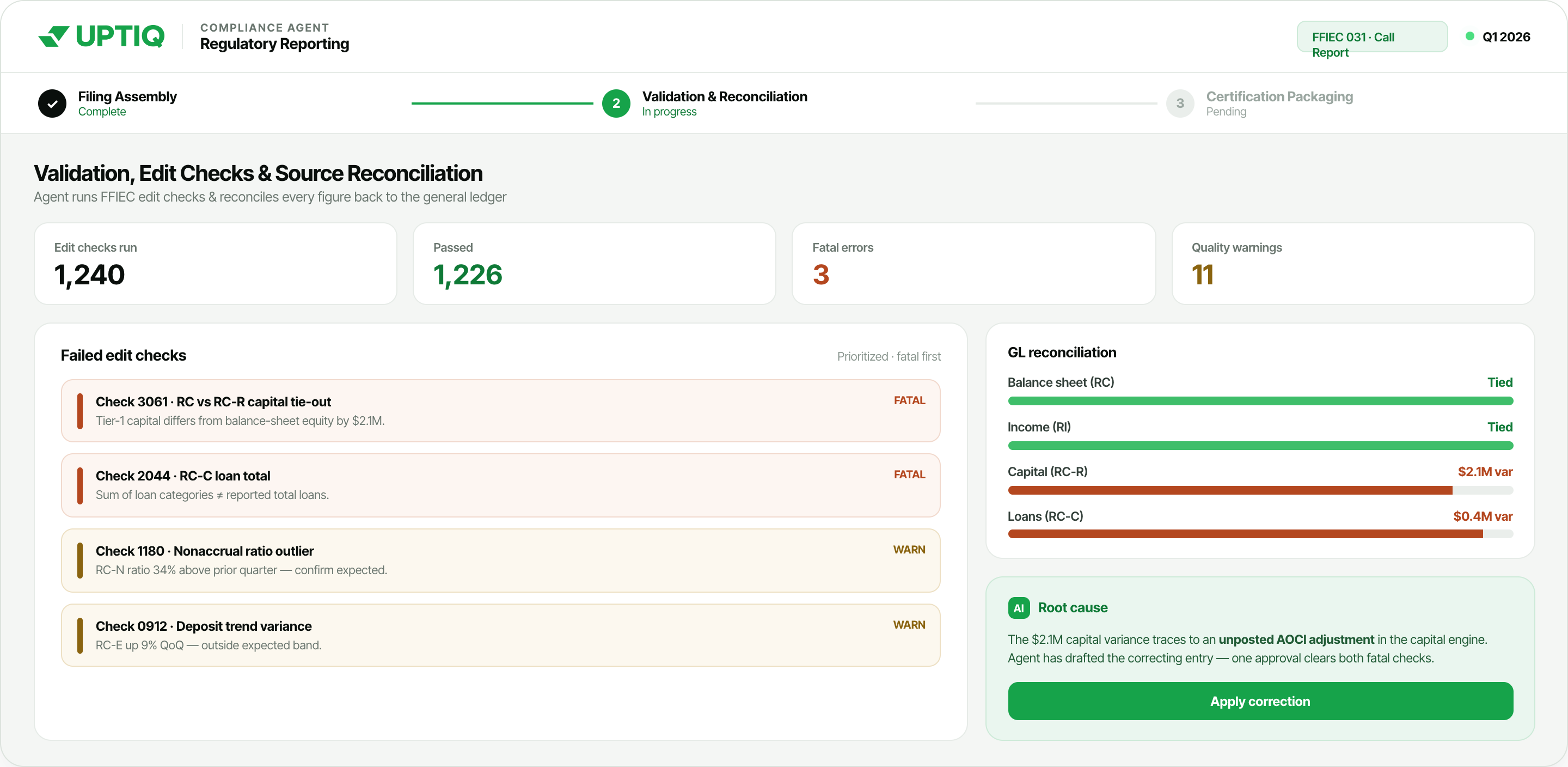
Source reconciliation compares each line item in the assembled filing against the corresponding balance in the institution's authoritative source systems, general ledger account balances, loan data system totals, deposit system balances, and operational report figures. When the assembled filing figure and the source system balance differ beyond the tolerance threshold configured for that line item, the discrepancy is flagged as a reconciliation finding for analyst review and resolution before the filing is packaged for certification.
The reconciliation is applied systematically to every filed figure on every cycle rather than as a spot-check on selected lines, which is the approach that manual reconciliation processes take out of practical necessity. Systematic reconciliation is what catches the specific types of filing errors that regulatory agencies flag most frequently: figures that are internally consistent across schedules but that diverge from the underlying data because of a data pull timing difference, a methodology inconsistency, or a source system update that was not reflected in the filing data.
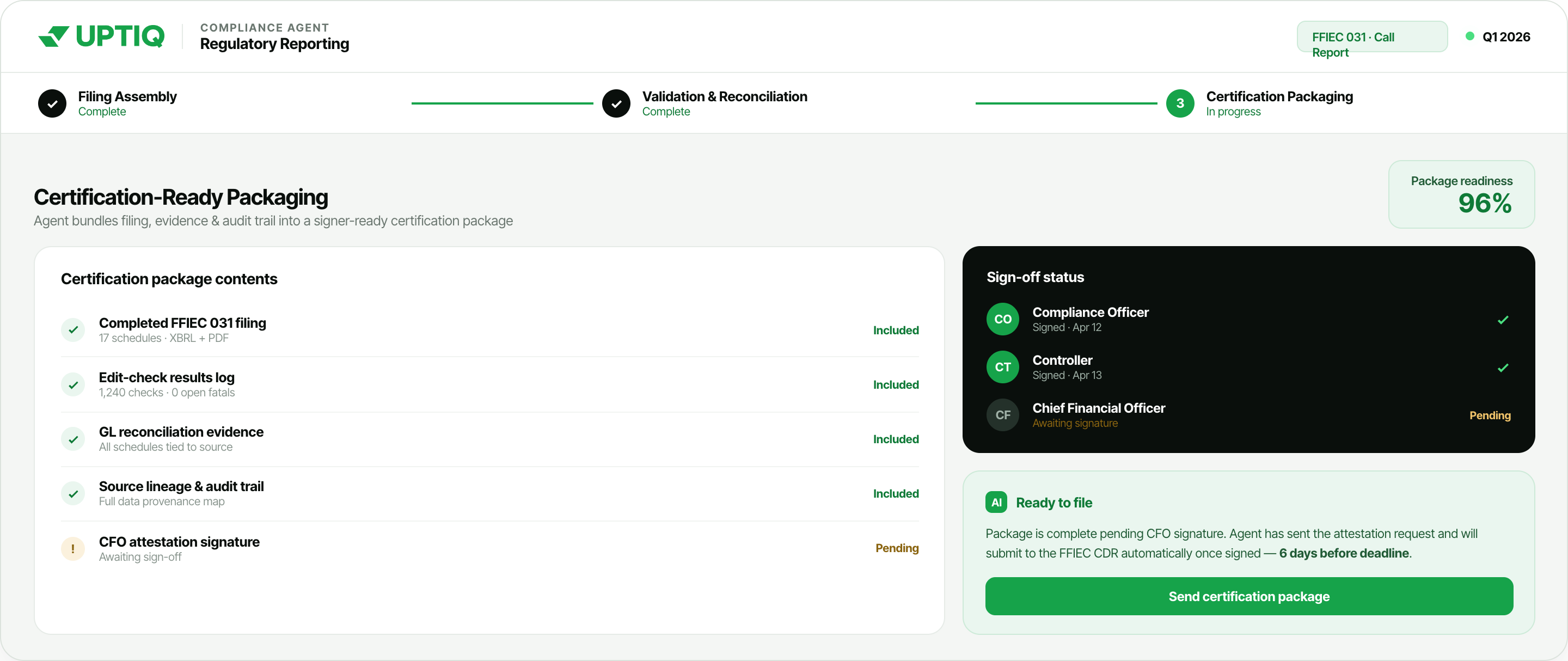
The certification package contains: the assembled filing in the regulatory submission format, the edit check results showing which checks passed and which produced findings, the source reconciliation summary showing the comparison between filed figures and source system balances, a period-over-period change analysis flagging material movements for certifier awareness, and a findings log documenting any unresolved validation flags with the analyst's documented rationale for the filed figure. This package is designed so the certifier can assess filing accuracy with confidence, not assume it because the preparation process ran without obvious errors.
The human certification step is preserved as an explicit, documented action in the filing workflow, the agent packages the filing for review, but the submission does not proceed until the designated certifier has reviewed the package and recorded their certification determination. This architecture keeps the regulatory accountability for filing accuracy exactly where it belongs: with the named individuals whose professional and legal responsibility the certification represents, supported by preparation and validation work that makes their review substantive rather than perfunctory.
Most institutions are preparing their first automated filing cycle within a matter of weeks. Uptiq handles data source integration, filing template configuration, edit-check rule implementation, and reconciliation threshold setup during deployment. For institutions approaching a specific filing deadline, deployment can be prioritized for that filing type first while additional filings are added in subsequent phases.
Many institutions run a parallel preparation cycle during deployment, preparing the filing both through the agent and through the existing manual process, to validate the agent's output quality against the manual process before the automated preparation becomes the primary production workflow. This parallel validation period typically runs for one to two filing cycles, after which institutions transition to agent-primary preparation with the existing manual process as a quality review rather than the primary assembly method.
Yes. The platform includes SOC 2 Type II compliance, encrypted data handling, role-based access controls that restrict filing data and reconciliation records to authorized finance and compliance personnel, and comprehensive audit logging of every data assembly, validation run, and packaging action. The complete audit log for each filing, from source data ingestion through validation to certification package delivery, is retained for the examination period applicable to each filing type.
The agent's data lineage architecture is designed to satisfy the traceability requirements that regulatory agencies and internal auditors apply when reviewing filing accuracy: every filed figure can be traced back through the calculation methodology to the specific source records from which it was derived. This lineage documentation is available for examiner review and is formatted to support the standard working paper request that regulatory examiners make when validating Call Report or HMDA filing accuracy.
Manual filing preparation processes are labor-intensive, timeline-compressed, and vulnerable to the specific error types that most frequently generate regulatory call-backs: data pull timing inconsistencies, calculation methodology errors that are not caught by internal review, and reconciliation gaps where filed figures are consistent across schedules but diverge from source data in ways that were not checked. These errors are not failures of competence; they are predictable outputs of a manual process operating under deadline pressure with multiple interdependent data sources.
The agent addresses the structural causes rather than the individual instances: systematic source reconciliation replaces spot-checking, automated edit-check runs replace manual review of filing instructions, and complete data lineage replaces the informal knowledge of which data was pulled from where. The certifiers who sign each filing receive a more thoroughly validated package than any manual preparation process can produce on a consistent basis, which is what allows them to certify with the confidence the regulatory accountability they carry actually requires.
Our team handles deployment end-to-end, from configuration to go-live. Most financial institutions are live within days, not months.