Ingest every regulatory change that matters to your institution, assess its impact precisely, map it to the policies, processes, and agents it affects, and track implementation through to completion, with examination-ready documentation at every step.


Replace manual regulatory horizon scanning, reactive policy update cycles, and undocumented implementation tracking with a structured change management workflow that monitors every relevant source, assesses impact against your institution's specific profile, and drives changes to closure.


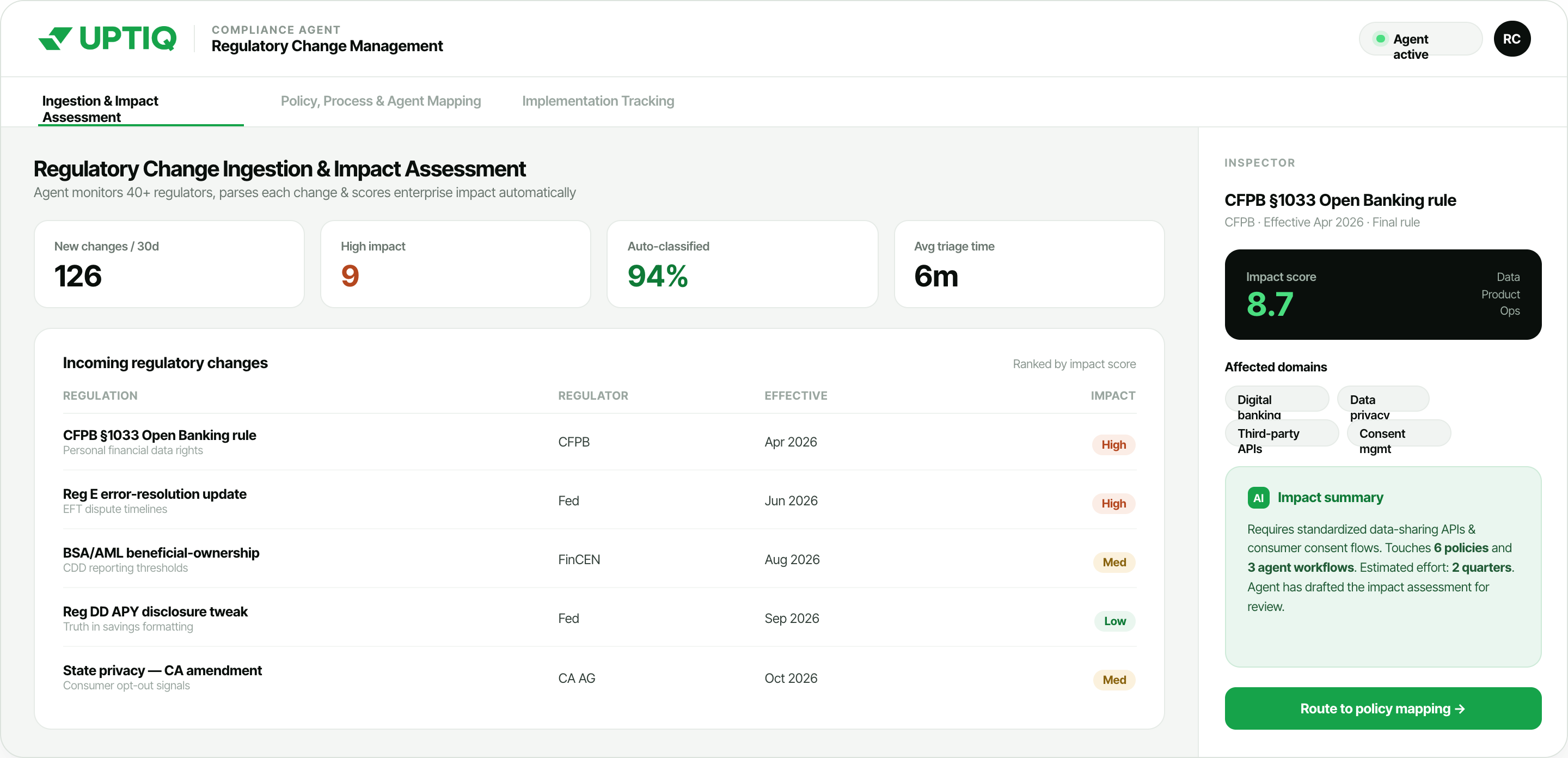
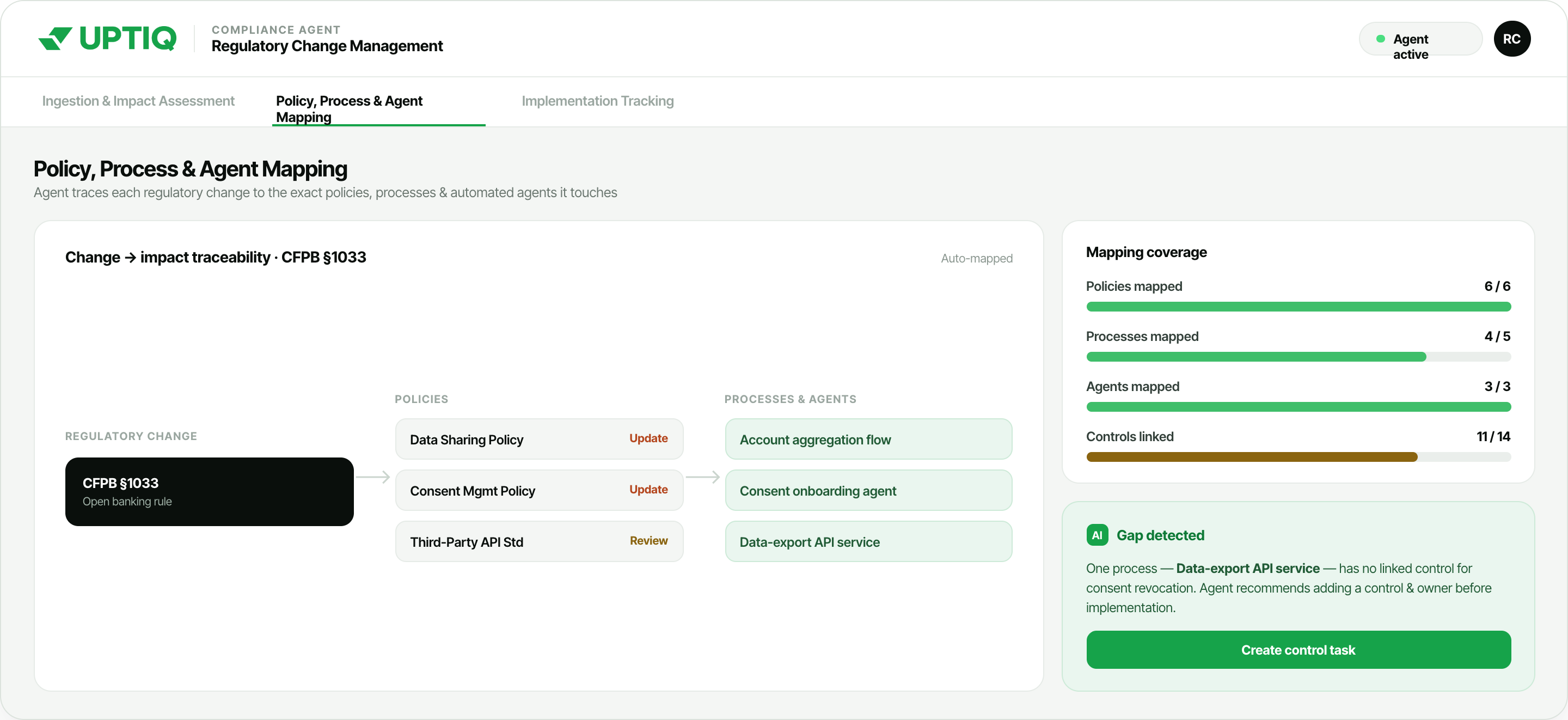
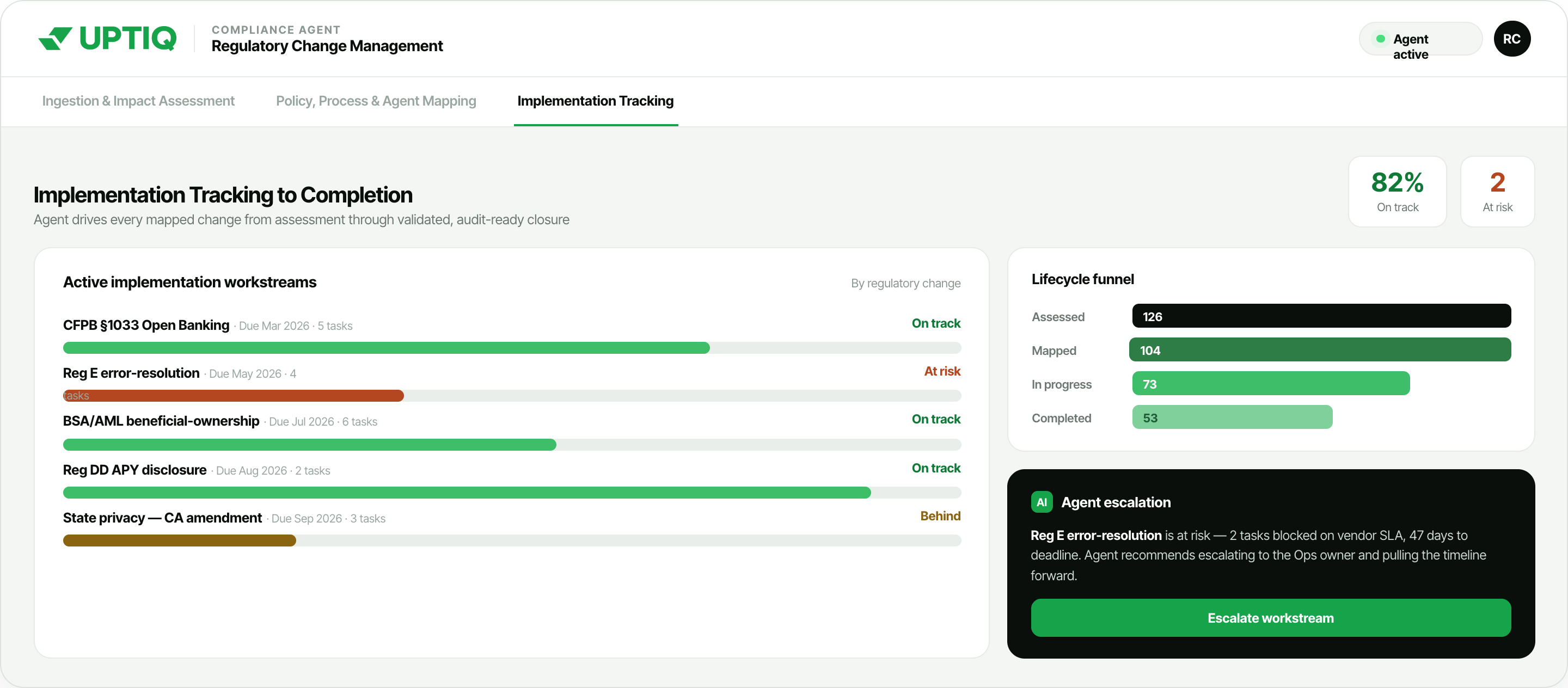
The Uptiq Regulatory Change Management Agent is an AI-powered solution that monitors regulatory sources continuously, ingests every change relevant to the institution's profile, assesses its institutional impact, maps the downstream effects to specific policies, processes, and AI agents, and tracks implementation to completion with examination-ready documentation. It keeps the institution's obligation set current without depending on manual horizon scanning, and it ensures that implementation actually reaches every affected area rather than stopping at compliance team awareness.
The result is a regulatory change program that catches every relevant change across federal, agency, and state sources; connects each change to the specific institutional components that require updating; and produces the organized implementation record that examiners look for when they ask how the institution has responded to recent regulatory developments. For institutions managing complex regulatory profiles across multiple product lines and jurisdictions, this comprehensive tracking is what separates a compliance program that stays current from one that perpetually plays catch-up.
The agent monitors a configurable set of regulatory sources matched to the institution's charter type, product set, and geographic footprint. Standard sources for US-chartered banks and credit unions include: the Federal Register for proposed and final rules, OCC bulletins and interpretive letters, Federal Reserve supervision and regulation letters, FDIC financial institution letters, NCUA regulatory alerts for credit unions, CFPB circulars and supervisory guidance, FinCEN advisory releases, and relevant state banking department publications. Additional sources are added for institutions with specialized charters, specific product lines, or multi-state operations requiring state-specific monitoring.
The monitoring scope is configured rather than generic, the agent does not simply flag every regulatory publication, but applies the institution's profile to filter for changes that carry implementation obligations relevant to its specific activities. This filtering is what distinguishes a regulatory change management tool that helps compliance teams from one that creates additional work by generating noise about changes that do not affect the institution's operations.
Impact assessment applies the institution's profile, charter type, product lines, customer populations, geographic footprint, and AI agent inventory, to each ingested regulatory change to determine which parts of the institution's operations are affected and what the nature of the implementation obligation is. The assessment distinguishes between three response types: changes requiring active implementation through policy revision, process modification, or system change; changes requiring awareness and monitoring without immediate implementation action; and changes requiring legal or expert review to determine applicability.
For changes requiring active implementation, the assessment produces an initial workplan that identifies the affected areas, the compliance deadline, and the implementation owners, formatted as a structured change workplan rather than a compliance memo that requires additional work before it can be acted on. The workplan is presented to the compliance officer for review, adjustment, and approval before it is assigned to implementation owners, preserving the human accountability for the institution's response strategy while removing the manual research and mapping work that currently consumes most of the assessment cycle.
The agent maintains an inventory of the AI agents operating within the institution's compliance and operations environment, synchronized with the Model Risk Management Agent's model and agent inventory, and applies regulatory change impacts to that inventory the same way it applies them to policies and processes. When a regulatory change affects the decision logic, disclosure requirements, or governance documentation for a capability that an AI agent automates, the agent is flagged in the change workplan alongside the corresponding policy and process items.
This is the mechanism that keeps the institution's AI governance program current as the regulatory environment evolves: new CFPB guidance on AI in credit decisioning, interagency model risk management updates, or state-level AI-specific requirements are automatically mapped to the AI agents whose operations they affect, rather than requiring a separate human assessment of AI governance implications after the general regulatory change process has concluded.
Most institutions are monitoring regulatory sources and ingesting changes within a matter of weeks. Uptiq handles regulatory source configuration, institution profile setup, policy and process inventory import, and GRC platform integration during deployment. Historical regulatory changes from the most recent examination period are loaded during deployment so the initial implementation tracking reflects the institution's current compliance posture rather than starting from a clean slate.
Many institutions begin with regulatory change ingestion and impact assessment, which produce immediate operational value by replacing manual horizon scanning, and add the structured workplan and implementation tracking capabilities in a subsequent phase once the compliance team has validated the assessment accuracy against their own subject matter knowledge. This validation phase is important because the agent's impact assessments reflect general regulatory requirements; the compliance officer's institutional knowledge refines them for the institution's specific circumstances before workplans are assigned.
Yes. The platform includes SOC 2 Type II compliance, encrypted data handling, role-based access controls that restrict regulatory change and implementation record access to authorized compliance and legal personnel, and comprehensive audit logging of every ingestion, assessment, and workplan action. Regulatory change content and implementation documentation are handled within the institution's configured data environment.
The agent's examination documentation output is formatted to satisfy the evidentiary standards that regulators apply when reviewing an institution's regulatory change management program, including the standard that implementation records must document what was done, when, by whom, and with what evidence of completion, rather than simply asserting that a change was implemented. This documentation standard is built into the output format rather than requiring additional formatting after implementation is complete.
Manual regulatory change tracking through spreadsheets and email folders has two fundamental limitations. First, it is only as comprehensive as the manual scanning process that feeds it, changes that are not individually found and logged by a team member are simply not tracked. For institutions with complex regulatory profiles across multiple product lines and states, the manual scanning process routinely misses changes from sources that are not part of a compliance team member's regular reading routine. Second, manual tracking produces a log of what was received rather than a managed work plan, it documents awareness without ensuring that implementation reached every affected area.
The agent addresses both limitations: continuous source monitoring ensures that every relevant change is ingested regardless of which team member happens to see it, and structured workplan generation ensures that implementation is tracked across every affected policy, process, and AI agent rather than stopping at the compliance team's awareness of the change. The examination documentation that results demonstrates a managed, systematic response to regulatory change rather than a record of the changes the compliance team happened to notice.
Our team handles deployment end-to-end, from configuration to go-live. Most financial institutions are live within days, not months.