Run fair-lending analytics across every credit decision, monitor marketing and disclosures for UDAAP exposure, and test compliance across the institution, including the AI agents making decisions on your behalf, before an examiner does it for you.


Replace periodic fair-lending reviews, manually audited marketing materials, and reactive UDAAP assessments with continuous surveillance that runs analytics across every decision, monitors disclosures in real time, and tests compliance before findings reach an examination stage.


The Uptiq Consumer Compliance / Fair Lending / UDAAP Agent is an AI-powered solution that runs fair-lending analytics across the institution's credit decisions, monitors products and practices for UDAAP risk, reviews marketing materials and disclosures for regulatory compliance, and executes structured compliance tests, producing the surveillance record that demonstrates active consumer compliance oversight rather than compliance by assertion. Critically, it extends this monitoring to the institution's AI agents, checking that automated decision outputs comply with the same requirements that apply to human decisions.
The result is a consumer compliance program that detects disparate-impact risk before it accumulates to examination significance, monitors UDAAP exposure continuously rather than reviewing it periodically, and produces documented testing evidence that satisfies examiner expectations for active compliance oversight. For institutions deploying AI agents in credit decisioning and customer interaction, the extension of compliance testing to those AI outputs is increasingly a regulatory expectation, not a future consideration.
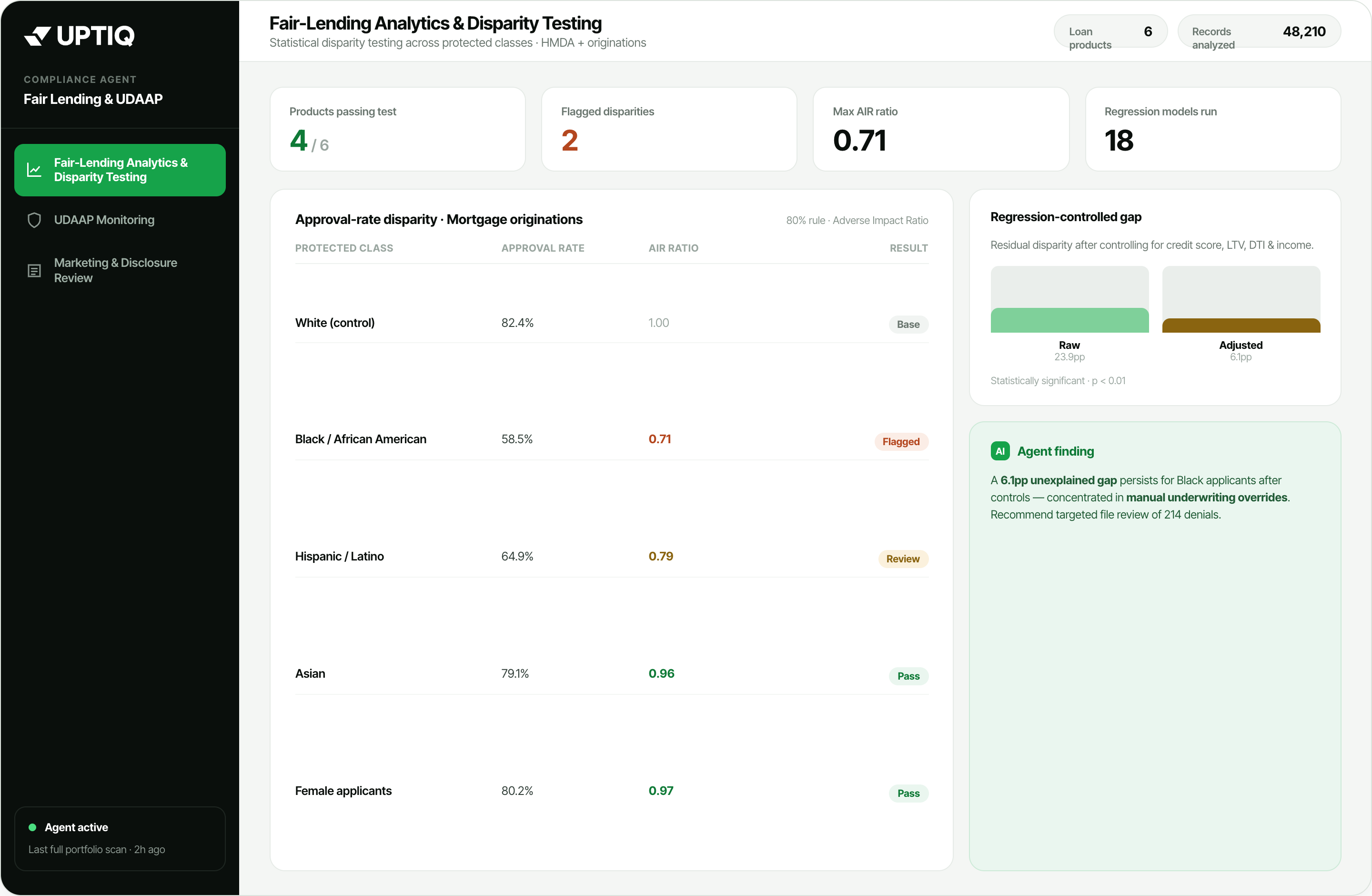
Fair-lending analytics applies statistical methods, primarily regression analysis and matched-pair testing, to the institution's credit decision data to identify whether protected class membership correlates with decision outcomes after controlling for legitimate credit factors. Disparity testing covers the four standard analysis types: comparative file review for potential disparate treatment, regression analysis for potential disparate impact, geographic analysis for potential redlining, and steering analysis for potential product channeling. Each analysis type is applied to the decision population relevant to the products and channels in scope for the review period.
Analysis runs continuously rather than on an annual or semi-annual cycle, which means the statistical dataset the agent works from is always current rather than representing a snapshot of a prior period. Continuous analytics detect emerging disparity patterns at the earliest stage, when the underlying cause is still identifiable and addressable, rather than after they have accumulated through multiple lending cycles into the concentrations that attract regulatory examination attention.
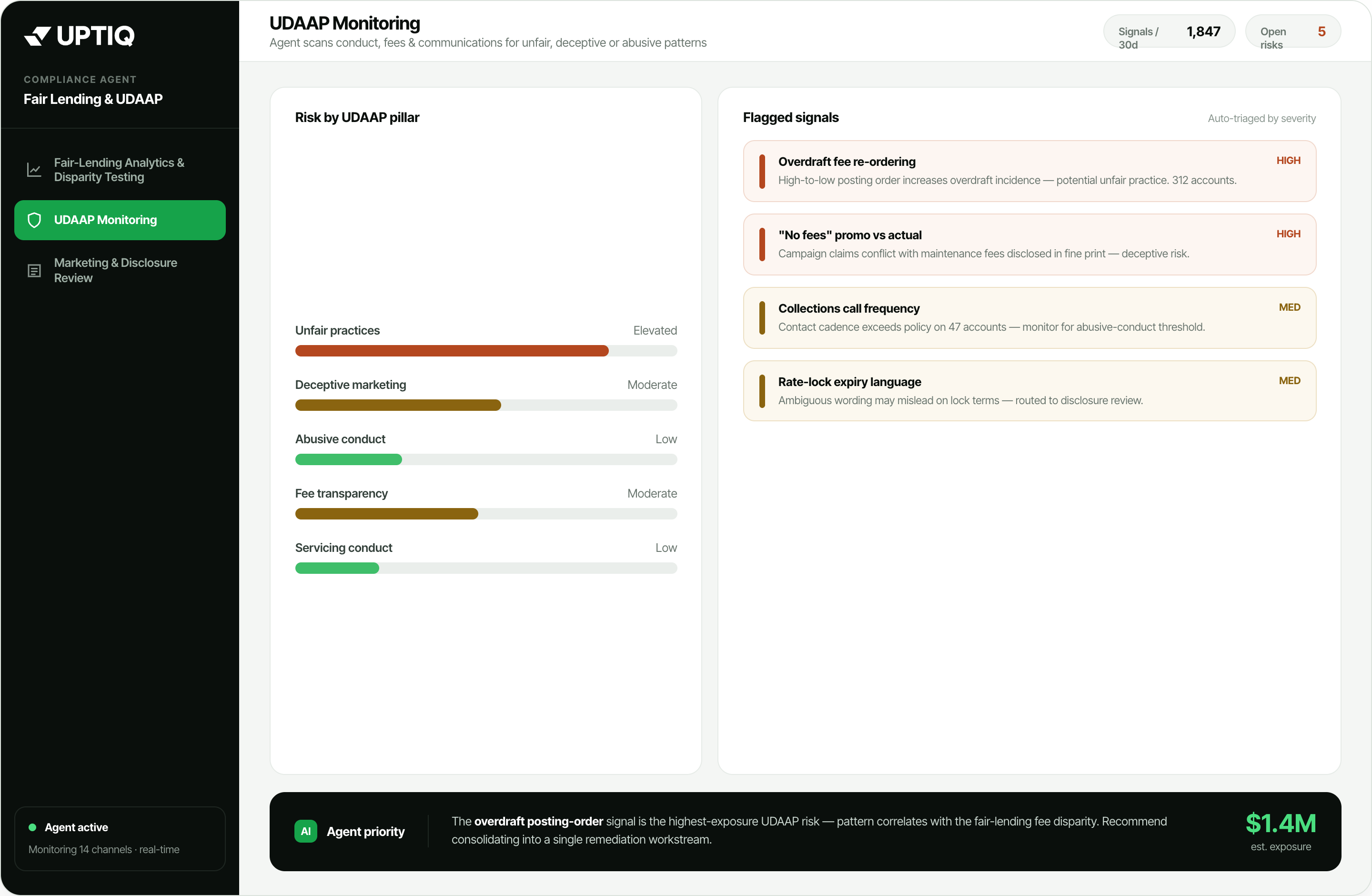
UDAAP monitoring applies the three-prong framework from the Dodd-Frank Act, unfair, deceptive, and abusive, to the institution's observable product and service behaviors. Unfairness monitoring checks whether product features, fee structures, or servicing practices cause substantial injury to consumers that they cannot reasonably avoid. Deception monitoring reviews whether marketing materials, disclosures, and communications contain representations that are misleading in a material way. Abusiveness monitoring checks whether any practice takes unreasonable advantage of a lack of consumer understanding or a consumer's inability to protect their own interests.
The extension to AI agent outputs addresses the regulatory reality that automated decisions and recommendations are subject to the same UDAAP framework as human ones, an AI agent that systematically produces unfavorable outcomes for a specific consumer population, or that generates materially misleading marketing recommendations, is creating UDAAP exposure regardless of whether a human reviewed the specific output. Monitoring AI agent outputs for these patterns is what distinguishes an institution with genuine AI governance from one with AI governance documentation that is never operationally tested.
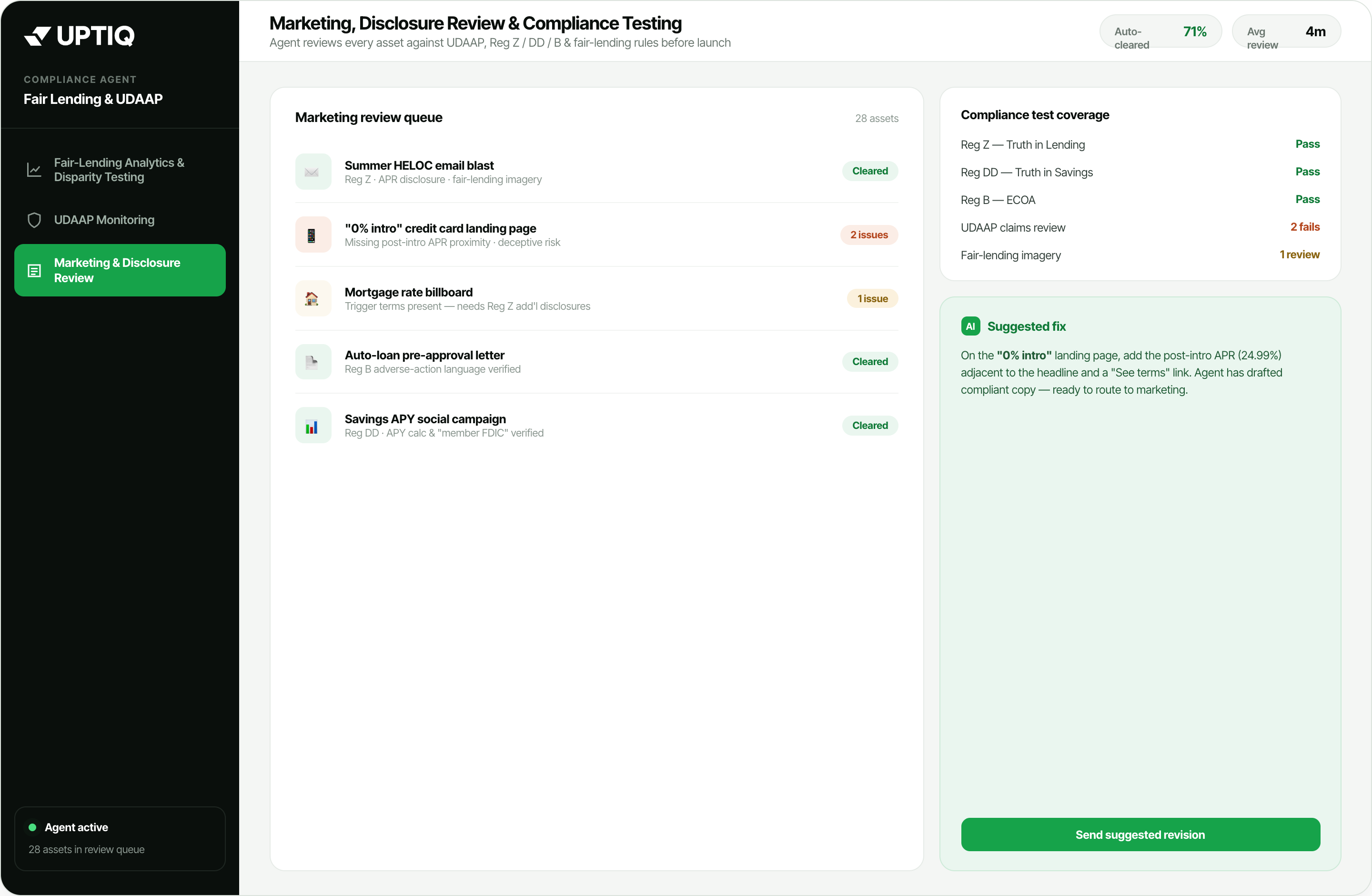
Marketing review covers consumer-facing materials across all channels, digital advertising, direct mail, email campaigns, website content, and in-branch materials, checking for the accuracy of rate and fee representations, the completeness of required disclosures, the prominence of material terms relative to promotional language, and the presence of claims that could be interpreted as misleading regarding product features, conditions, or costs. Review is triggered both at the point of new content approval and continuously for materials already in market.
Disclosure review applies the specific content and format requirements of the applicable regulatory frameworks like Regulation Z for credit products, RESPA for mortgages, TISA for deposits, and UDAAP for all consumer-facing communications, to the institution's current disclosure set. Gaps and inaccuracies are flagged for compliance review and correction before they generate borrower complaints or examination findings. The review record documents which materials were reviewed, which issues were identified, and how each was resolved, producing the compliance evidence that examiners look for when assessing the effectiveness of the institution's marketing compliance program.
Most institutions are running initial fair-lending analytics and UDAAP monitoring within a matter of weeks. Uptiq handles loan origination system integration, decision data field mapping, marketing content platform connection, and compliance testing framework configuration during deployment. Historical decision data covering the most recent regulatory review period is loaded during deployment so the initial fair-lending analysis reflects a meaningful statistical population rather than starting from a small current-period sample.
Many institutions begin with fair-lending analytics and disclosure review, the two capabilities with the most direct examination preparation impact, and add continuous UDAAP monitoring and AI agent output testing in a subsequent phase. This phased approach is particularly common for institutions that are simultaneously deploying new AI decisioning tools and want to establish the compliance monitoring baseline before expanding the scope of AI agent oversight to cover those new deployments.
Yes. The platform includes SOC 2 Type II compliance, encrypted data handling, role-based access controls that restrict fair-lending analysis data and UDAAP monitoring findings to authorized compliance personnel, and comprehensive audit logging of every analysis run, finding, and review determination. Consumer decision data, including the protected class characteristics that fair-lending analytics requires, is handled within the institution's configured data environment and is never shared outside the defined compliance surveillance workflow.
The agent's fair-lending analytics framework is designed to produce findings that satisfy both the statistical methods and the documentation standards that CFPB, OCC, FDIC, and Federal Reserve examiners apply when evaluating an institution's fair-lending compliance program. This means the outputs are formatted for examiner review from the start, not produced as internal analysis that must be reformatted and contextualized before it can be shared with a regulatory audience.

Periodic fair-lending reviews are snapshots, they analyze a defined window of decision data, produce findings about what occurred in that period, and are filed until the next review cycle begins. The time between when a disparity pattern emerges and when a periodic review detects it can span months, during which the pattern continues accumulating in the decision data. By the time the periodic review finds it, the concentration may already be at a level that will concern an examiner, and the operational cause may be more difficult to trace than it would have been at the point of emergence.
Continuous fair-lending analytics detects patterns in near real time and surfaces them at the earliest statistical significance threshold, when the cause is still identifiable, and the accumulation is still small enough to be addressed operationally before it becomes a formal compliance concern. The difference in outcomes is material: institutions that identify and address fair-lending disparity patterns proactively before examination cycles can demonstrate the kind of compliance culture that examiners treat differently from institutions that address findings only after they are surfaced externally.
Our team handles deployment end-to-end, from configuration to go-live. Most financial institutions are live within days, not months.