Aggregate complaints across every channel, classify them for systemic analysis, surface emerging issues before they reach your regulator, and build the data foundation that makes your response program defensible from the first inquiry.


Replace channel-by-channel complaint reviews, manually assembled trend reports, and reactive regulator responses with a unified complaint surveillance workflow that aggregates, classifies, and analyzes every complaint, surfacing systemic patterns and emerging issues in real time.


The Uptiq Complaint Analytics & Surveillance Agent is an AI-powered solution that aggregates complaint data from every channel the institution uses, classifies each complaint against a standardized taxonomy, and runs continuous trend and root-cause analytics across the unified complaint dataset. It operates as the surveillance layer above individual complaint handling, the function that identifies when isolated complaints represent a systemic pattern, and that builds the data foundation needed to respond credibly to regulatory complaint inquiries.
The result is a complaint management program that catches emerging issues while they are still correctable, generates root-cause findings that business units can act on rather than complaint counts that require further interpretation, and produces the organized, trend-supported documentation that regulators expect to see when they ask how the institution monitors its complaint experience. By connecting complaint data across channels, the agent surfaces the patterns that channel-by-channel complaint handling was structurally unable to see.
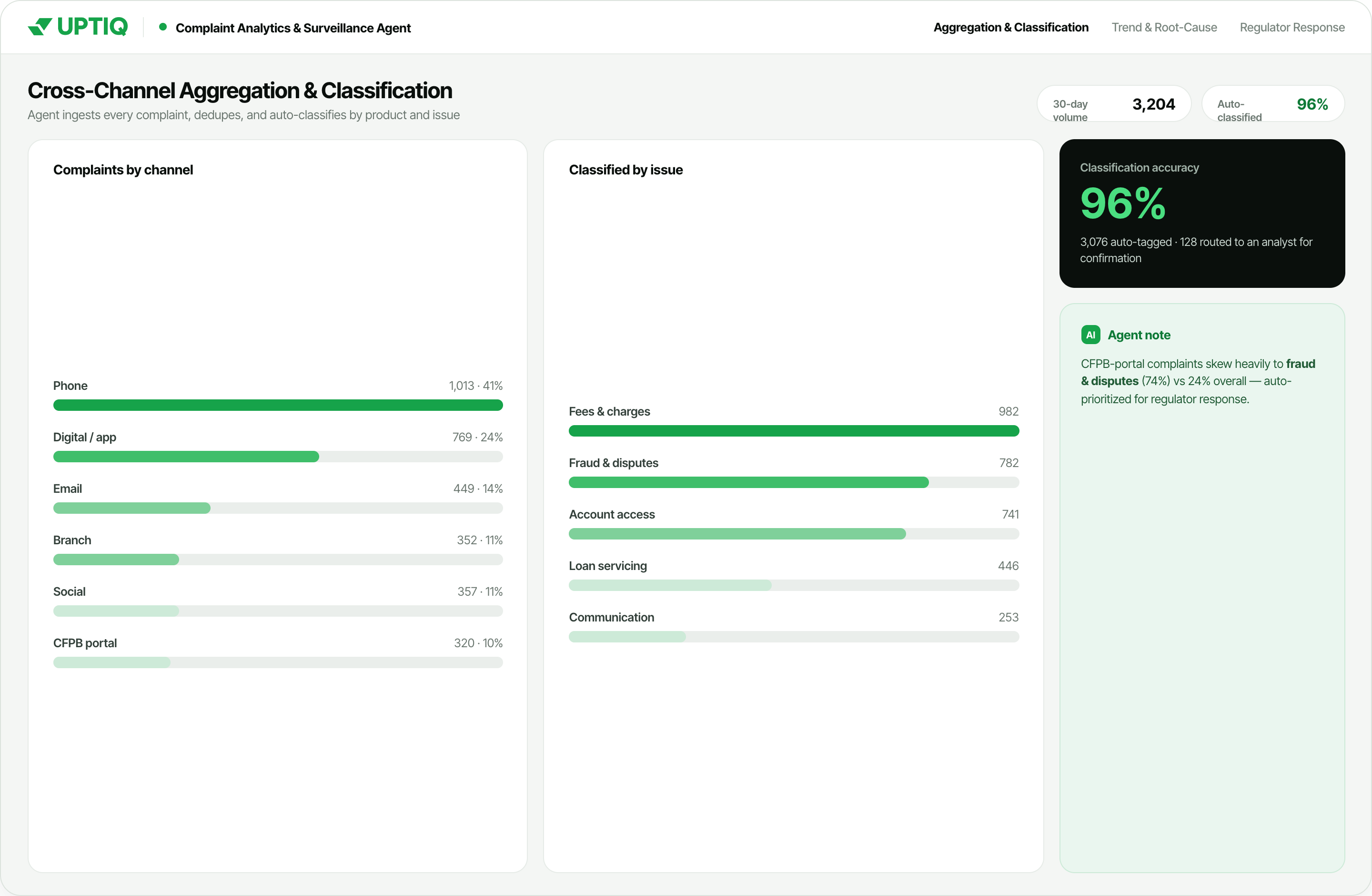
Most financial institutions handle complaints through channel-specific processes: the branch manager resolves branch complaints, the call center handles phone complaints, and the digital team manages web and app complaint submissions. This structure means that a product issue generating complaints across multiple channels appears as a low-volume, isolated event in each channel's reporting, even when the aggregate complaint volume is significant enough to indicate a systemic problem. Cross-channel aggregation is what makes the actual pattern visible.
The regulatory significance is direct: CFPB examinations and state regulatory inquiries increasingly ask institutions to demonstrate that they are monitoring complaint patterns across all channels, not just managing individual complaints through resolution. An institution that can produce a cross-channel complaint trend report with root-cause analysis presents a demonstrably more mature complaint management program than one that can only show individual complaint resolution records, and that maturity difference affects examination outcomes.
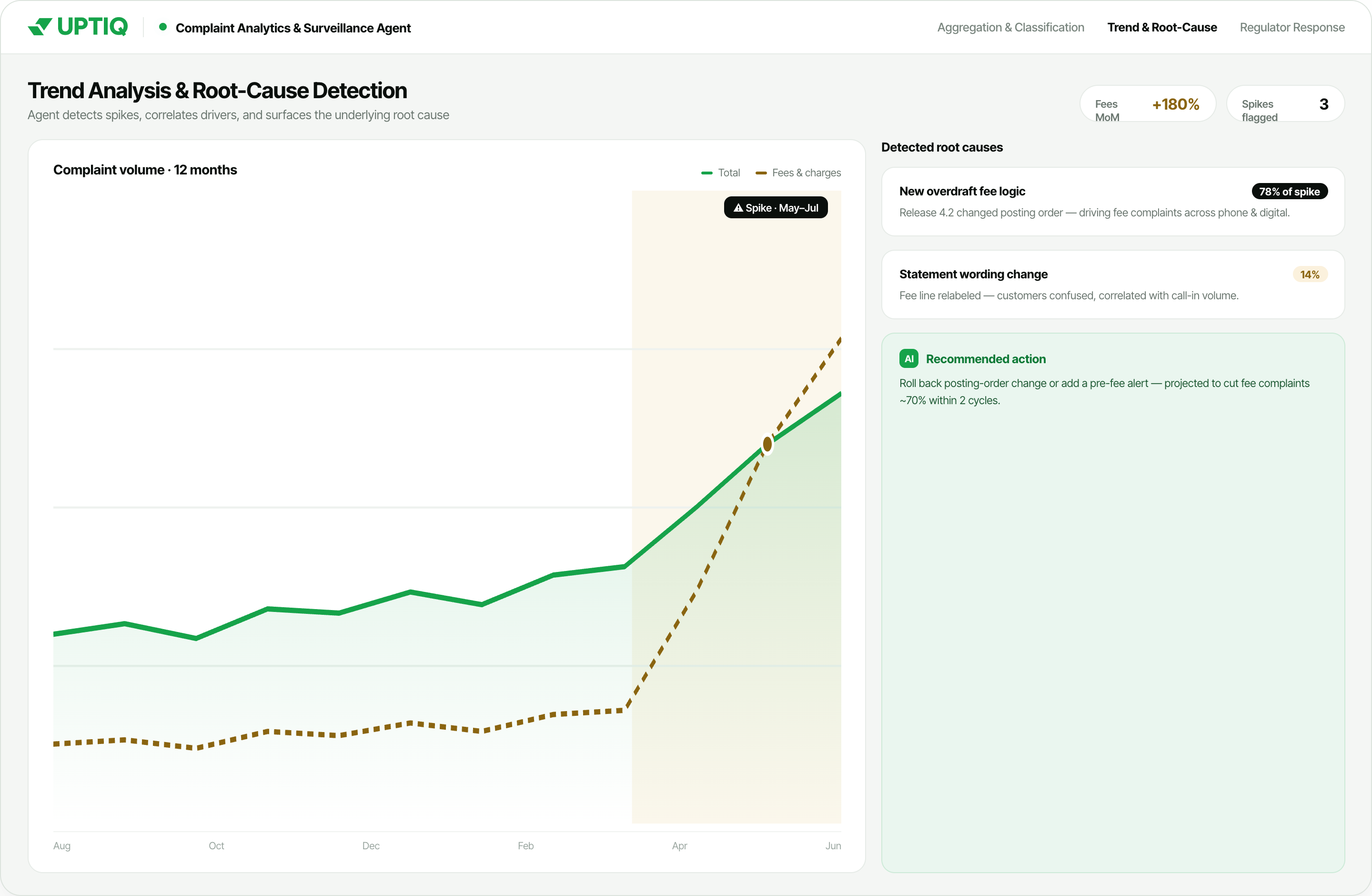
Root-cause analysis begins with the complaint classification taxonomy, each complaint tagged by product, issue type, sub-issue, and the specific operational interaction that generated it. When complaints cluster around a specific issue type in a specific product area, the agent surfaces the cluster as an emerging pattern and identifies the candidate root causes based on the operational processes, system behaviors, and policy provisions that the affected product area relies on. Root-cause candidates are presented as structured findings for compliance and business unit review rather than as automated determinations.
The value of this output is in what it enables: a business unit receiving a finding that says "23 complaints in the past 30 days cite incorrect fee disclosures on product X, concentrated among accounts opened through channel Y after the system update on date Z" can identify and remediate the specific cause, whereas a business unit receiving a finding that says "complaint volume on product X is elevated" must conduct the root-cause investigation itself before remediation is possible. The agent compresses the time between complaint pattern detection and actionable root-cause identification.
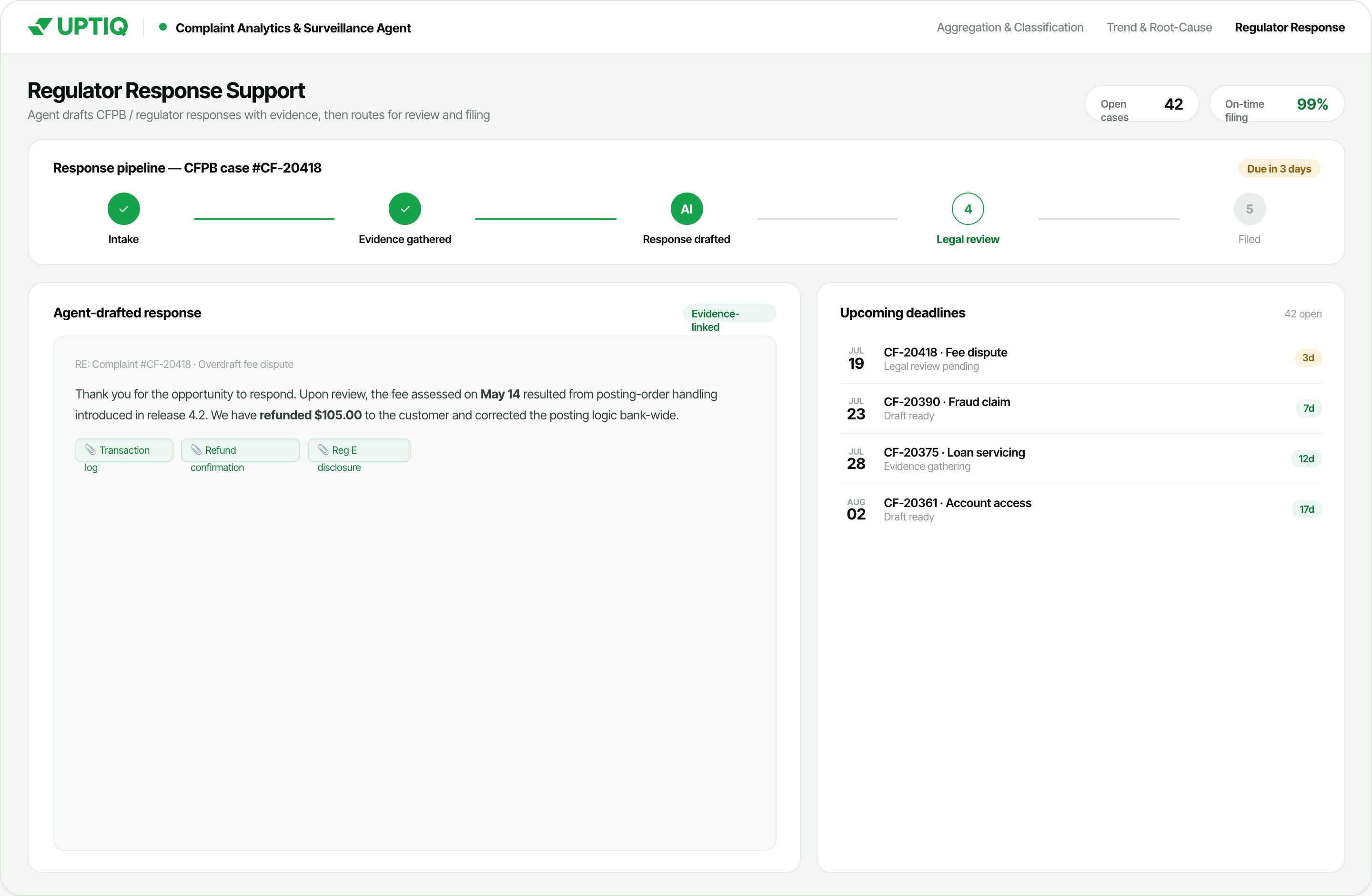
When a regulatory complaint inquiry arrives, a CFPB supervisory examination, a state regulator request for complaint data, or a formal complaint referral, the agent assembles the response package from the aggregated complaint dataset. This includes the complaint records responsive to the inquiry, trend data showing how complaint volume and issue composition have changed over the relevant period, root-cause findings documenting how identified issues were investigated and addressed, and management response documentation showing what corrective actions were taken.
Response packages are presented to management and legal for review and approval before submission. The complete underlying complaint record remains accessible for examiner follow-up questions, which frequently arise after an initial submission when an examiner wants to drill into a specific complaint or issue category in more detail. Having the full dataset organized and accessible rather than requiring additional manual assembly for each follow-up question is what allows institutions to respond to examiner follow-ups promptly rather than requesting extensions.
Most institutions are ingesting complaint data across all configured channels and running initial trend analysis within a matter of weeks. Uptiq handles channel integration configuration, taxonomy setup aligned to the institution's existing complaint coding and CFPB reporting categories, and alert threshold calibration during deployment. Historical complaint data is migrated during deployment so the initial trend analysis reflects an actual baseline rather than starting from zero volume on go-live day.
Many institutions begin with the channel aggregation and trend monitoring capabilities, which produce immediate analytical value, and add regulator response support workflows in a subsequent phase once the team has validated the quality of the aggregated dataset and complaint classification accuracy. The migration of historical complaint data during deployment is what makes the trend analysis meaningful from day one, trend detection requires a baseline, and building that baseline from scratch after go-live would delay the analytical value by months.
Yes. The platform includes SOC 2 Type II compliance, encrypted data handling, role-based access controls that restrict complaint record and trend data access to authorized compliance and operations personnel, and comprehensive audit logging of every classification, analysis, and response package assembly action. Consumer complaint data, which frequently includes PII and sensitive financial account information, is handled within the institution's configured data environment and is never shared outside the defined surveillance workflow.
The agent's CFPB complaint taxonomy alignment ensures that complaint classification is consistent with the reporting categories that regulators use to analyze complaint patterns across institutions, which matters both for regulatory response quality and for the institution's ability to benchmark its complaint experience against peer institutions using publicly available CFPB complaint database data.
Complaint management software is designed to track individual complaints through resolution, logging intake, routing to the responsible team, recording the resolution, and closing the ticket. It is not designed to aggregate patterns across channels, run statistical trend analysis, identify root causes across complaint clusters, or assemble regulator response packages with trend documentation. The agent sits above the complaint management system rather than replacing it, adding the surveillance and analytics layer that individual complaint tracking was never designed to provide.
The distinction matters practically: an institution whose complaint management software shows that every complaint was resolved within the required timeframe has documented its handling process adequately. An institution that can also show what complaint patterns emerged, what root causes were identified, what corrective actions were taken, and how complaint volume and issue composition changed as a result has demonstrated the systemic oversight that examiners are increasingly asking for, and that the agent produces as a byproduct of continuous cross-channel surveillance.
Our team handles deployment end-to-end, from configuration to go-live. Most financial institutions are live within days, not months.