The Future of Client Engagement in Wealth Management

In wealth management, investor expectations are shifting, dynamically shaped by digital-first banking, on-demand services and consumer technology, where interactions are personalised, access to information is instant and service experience is smooth across channels. Modern investors expect hyper-personalised advisory services with real-time visibility to portfolio, timely insights with a blend of human expertise for judgement and digital efficiency for convenience.
In this dynamic environment, RIAs and wealth firms face structural constraints like a complex regulatory environment, a fragmented technology ecosystem, an advisor headcount shortage and inconsistent client experience. Within this context, AI-powered Client Engagement Agents are emerging as a new category of capability rather than a single product or tool. These models operate as intelligence, orchestration and interaction layers across the entire client lifecycle. They integrate data from portfolio, planning, service, communication channels and compliance frameworks to surface insights and suggest next-best actions for advisors’ review. These engagement agents coordinate outreach in ways that augment, rather than replace, professional human judgment.
Responsible implementation of AI-powered engagement agents with a robust governance framework extends the reach of human expertise by enabling wealth advisors to act with greater relevance, awareness, and consistency. For RIAs and wealth firms, the strategic benefits of embedding AI-powered engagement agents are multi-dimensional, which reinforces trust among clients and regulators. The model enables personalisation at scale, boosts advisor productivity, enhances client satisfaction, and strengthens transparency, all while adhering to compliance requirements.
This eBook explores how AI-powered client engagement models can help wealth management firm to move from reactive to proactive strategies by serving as a connective layer.
In a modern investing world, wealth management is no longer solely performance-driven. While portfolio performance is important, modern investors define the quality of wealth management services based on the responsiveness, convenience and personalisation they experience. This evolution is mainly being driven by digital transformation across the financial services industry, where intuitive interfaces, real-time access, and personalised experiences have become the norm
Digital-first financial services, on-demand services and FinTech offerings that shape modern investors’ expectations provide a real-time, digitally orchestrated, interactive and hyper-personalised experience. Clients are expecting the same level of immediacy and priority from their wealth advisors. The transformative shift in wealth management opens the door for AI-powered client engagement models, making client engagement a superpower for RIAs and wealth management firms.
Client engagement is no longer just a ‘service function’, but a ‘strategic differentiator’. The ability to provide always-on, hyper-personalised, holistic and client-centric solutions is emerging as the defining capability for leading wealth management firms. Client engagement is now affecting the business outcomes across the wealth management landscape. The key aspects of client engagement include:
Today, modern investors expect wealth advisors to have a deeper understanding of their goals and then provide hyper-personalised solutions with proactive communication. Personalisation is no longer a luxury, but a baseline. Here are some interesting data as per the survey:
Digital-first experience is one of the key strategic aspects of client engagement in today’s wealth management. Changing expectations of young investors call for interactive, personalised, and seamless high-tech platforms that offer real-time insights and an omnichannel experience. The London Stock Exchange Group’s research says approximately 68% of investors expect their digital experience to match the leading technology platforms. And, 76% of millennial investors use mobile apps to access their investment portfolio, highlighting the digital-first experience trend. Studies also show 44% of investors (in 2024) strongly agreed that they expect digital goal-based planning experiences over passive reporting.
Investors are increasingly adapting to digital client engagement models, relying mainly on digital channels for interactions and services. However, clients also value human insights and guidance for high-stakes and complex decisions. This dual expectation, a good mix of high-tech digital efficiency and human expertise, is redefining the ‘client engagement’ in the modern advisory context as a hybrid (high-tech/high-touch) service model.
The wealth management industry is experiencing a massive intergenerational wealth transfer (estimated to be around $84 trillion), primarily from baby boomers to Gen X and millennials by 2045. With the ‘great wealth transfer’, the context of ‘trust’ is also evolving in wealth management. RIAs and wealth firms now face challenges due to distinct expectations from new generation clients. Young investors demand greater transparency in investing decisions and a clear explanation for every recommendation. Digital tools are offering this transparency through real-time reporting, data and rationale for every decision via explainable AI. Studies state that 73% of millennials prefer digital channels to communicate regularly with their advisors
The Client Engagement Gap: The engagement gap, a space between clients’ expectations and wealth advisors’ offerings, is an industry-wide challenge in the wealth management space. Specifically for RIAs and wealth firms that are supported by traditional systems and processes, the engagement gap is wider. Fragmented technology systems, outdated communication channels and a shortage of qualitative talent are some of the key drivers of the engagement gap. Traditional engagement model results in variability, where some clients get proactive, highly-personalised service, while others may receive only episodic and transactional interactions. This limits wealth firms’ ability to deliver consistent engagement, failing to meet clients’ expectations and eroding trust over time.
However, the engagement gap is not just a technology problem, but a structural challenge for modern wealth management firms. Focusing on proactive outreach, hybrid engagement models and adapting advanced digital tools are crucial to bridge the gap.
Wealth management firms are under growing pressure from operational and structural challenges, hampering their ability to deliver proactive, consistent and more personalised engagement. These challenges stem from the inability to expand their digital infrastructure, advisor headcount, operational capacity and rising regulatory burden. The result is a fundamental stain – fragmented workflows, advisor capacity constraints, inconsistent client experience and reactive communication. Together, they become constraints to scale a sustainable AI-powered client engagement agents to bridge the engagement gap.The current challenges in client engagement include:
The ‘advisor capacity’ constraints are one of the most well-documented and persistent challenges to boost client engagement. Studies show that wealth advisors spend more than 40% of their working hours on non-client-facing administrative work, such as reporting, meeting preparation, documentation, CRM upkeep, scheduling and more. With a significant portion allocated to behind-the-scenes work, only a fraction of hours is left for direct client interaction and strategic engagement
While the demand is growing for advisory services, the advisor headcount is declining. According to McKinsey’s report, the US wealth management industry is estimated to face an advisor capacity shortage of around 30% to 38% of the current advisor headcount (approximately 90,000 to 110,000 advisors) by 2034, considering 42% of advisors in the industry are expected to retire in the next ten years.
This emerging challenge reduces opportunities for insight sharing, proactive outreach and strategic engagement. The McKinsey report suggests that wealth firms and RIAs would need to recruit 30,000 to 80,000 net new advisors over the next ten years to bridge this gap, simultaneously boosting advisor productivity by 10% to 20%.
Traditional client engagement models in wealth management are fundamentally reactive, where the client initiates the contact, especially during a market event, major life events or for periodic review of their portfolio. This event-based engagement lets advisors miss many critical opportunities to offer valuable insights at the right time.
While the reactive client engagement model remains common, responding to inquiries, periodic portfolio reports and scheduled reviews are no longer enough. Today’s digital native investors expect proactive, real-time, data-based, insight-driven engagement. Though the proactive model can be an operational huddle for many RIAs and wealth firms, the benefits are noteworthy.
Here are the real-world cases of AI-powered engagement models delivering profound results:
Technology fragmentation is one of the critical structural challenges to client engagement in the wealth management space. Despite investments in digital tools in the past few years, many RIAs and wealth firms remain burdened with fragmented systems that operate in silos. When critical data sits in different silos with multiple isolated applications such as CRM, planning tools, and a portfolio management platform, a communication channel and compliance systems, it becomes difficult for advisors to navigate. A fragmented technology ecosystem slowly impacts the growth and client engagement quality, creating a visibility gap. An AI-powered unified engagement ecosystem can bridge the visibility gap by helping advisors to identify behavioural signals, major life/market events and portfolio shifts for strategic client engagement via orchestrated data and actions.
Inconsistency in client experience is a critical challenge across segments in most of the wealth firms, weakening loyalty and trust. Differences in the client onboarding journey, level of personalisation, variable response time, and service tier gaps based on client segments resulting from fragmented workflows are considered the main causes of inconsistency.
Avaloq study found that nearly 44% of wealth advisors call their system outdated, expressing low faithin it. Studies also state that 68% of investors expect a better digital experience and find current portals to be outdated without modern features.
Investors can now easily benchmark their experience with many digitally sophisticated financial services platforms and WealthTech apps, addressing the inconsistency challenge, which is critical for most RIAs and wealth firms to stay relevant.
Changing compliance requirements and the regulatory pressure add both friction and risk to the client engagement process. RIAs and wealth firms that operate in a highly regulated industry with stringent regulatory requirements must devote extensive time to ensure every process is auditable. This includes client interaction, documentation, KYC, investment recommendation, ESG disclosures, communication, privacy laws and every other process that needs to be well-documented.
The structural issues and compliance requirements translate into daily friction, taking away advisors’ time from strategic client engagement. AI-powered client engagement agents reduce this operational strain on advisors, allowing them to focus on strategies and strengthening client relationships.
AI-powered client engagement agents trigger data-driven proactive outreach, reduce errors, and manual handoffs, and standardise communication to overcome structural challenges and enhance client engagement. Many large wealth management companies and WealthTech firms have already deployed these intelligent agents and experienced measurable results. For RIAs and wealth firms, it is important to consider how quickly they can integrate AI-powered agents into their client engagement architecture.
Artificial intelligence is a broad term that is used to describe diverse technologies from basic automation and chatbots to predictive analytics. AI-powered client engagement agents in the wealth management context are far beyond basic automation and conversational chat interfaces. They represent a layered and orchestrated digital capability that extends across a wealth client’s entire lifecycle by connecting intelligence, data and human workflows.
In simple terms, an AI-powered client engagement agent keeps a detailed memory of a client’s preferences, history, risk profile, market and life events, compliance requirements and every other detail by integrating information from CRMs, portfolio management systems, communication channels, planning tools, reporting, and compliance frameworks. The core purpose of AI-powered client engagement agents is not to replace human advisors but to empower them in every step of the client’s lifecycle.
KPMG’s report, ‘Agentic AI in Wealth Management,’ defines AI-powered agents as tools that take independent, meaningful action with advanced intelligence, orchestration, data mining, knowledge, tools and governance, allowing efficient execution of end-to-end processes. According to KPMG’ sanalysis, wealth firms using AI-powered client engagement agents report 55% higher operational efficiency and a 35% reduction in average costs.
AI-powered client engagement agents leverage intelligence using LLM (Large Language Model) models for reasoning, predictive analysis, learn and adapting continuously to new situations from interactions and feedback. In wealth management, it helps in building a hyper-personalised, holistic portfolio for the client and delivers real-time advice. According to Wipro’s report, ‘AI in Wealth Management’, 77% of the firms have seen improved decision-making with AI-powered predictive analysis, and 76% firms have reported improvements in operational efficiency.
Real-world Example: AI @ Morgan Stanley Assistant is a classic example of how an AI agent adapts and learns from interactions, feedback loops, firm-specific trainings and continuous refinement. Nearly 98% of their advisors have already adopted an AI assistant to navigate the value chain and to get tailored and actionable insights.
Orchestration is the primary differentiator of AI-powered agents from isolated AI tools. Once the intelligence layer generates insights, the orchestration layer enables AI agents to integrate information from multiple tools, APIs, and workflows on a real-time basis and then triggers an action for advisors, operation and compliance teams.
Real-world Example: JP Morgan Chase’s Ask D.A.V.I.D (Data Analytics, Visualization, Insights, and Decision-making assistant) is a premier example of how AI agent orchestration works in wealth management. Let us say, their advisor inputs a query as – ‘’review particular client’s portfolio for retirement goals’’. For this query, ask D.A.V.I.D does a multi-level research and give actionable insights for the advisor to review. Here is the orchestration flow:
Basic automation and RPA (robotic process automation) based chatbots in wealth management are designed on set rules that reduce the operation burden by automating manual workflows to a certain extent. AI agents extend the automation by three core capability layers (intelligent, orchestration and interaction), focusing on scale without rigidity. Here are the key differences between basic automation and AI-powered agents:
AI agents are not just an upgrade in technological infrastructure; they bring a shift in operating model to the wealth management firms. Many large wealth management companies are already embedding AI-powered client engagement agents.
RIAs (Registered Investment Advisors) and wealth firms must focus on integrating AI Client Engagement Agents that can bring a paradigm shift for business scalability and growth over the long term. They preserve human roles for judgment and empathy while scaling the "always-on" engagement client sdemand, addressing capacity shortages and data overload. Integrating with existing tech tools, partnering with WealthTech providers, or AI co-pilots are good considerations for strategic implementation.
AI-powered client engagement agents extend across the wealth management value chain, from client onboarding to proactive outreach and servicing. These agents leverage intelligence, orchestration, and memory to personalize client engagement at scale. When embedded across the entire client lifecycle, AI-powered agents can create greater strategic value by augmenting human advisors. Integration of AI agents into the client’s lifecycle transforms a wealth firm’s operational model into an ‘always on’, proactive system.
Client onboarding is a high-friction point in a wealth management value chain, as manual KYC, documentation, verification and risk profiling can take several days or weeks. Industry data also shows how early experiences of clients shape their long-term perception of service quality and trust. Despite being a critical part of the lifecycle, onboarding remains highly error-prone due to multiple handoffs, manual data entry and complex regulatory requirements.
AI-powered client engagement agents can support RIAs and wealth management firms in a more disciplined and structured way, providing a frictionless client onboarding journey. These AI agents can extract data from documents, guide clients throughout documentation, verify from external sources and make an initial risk assessment while asserting a conversational context. The KPMG report states that AI agents in wealth management creates precise risk profile of clients from huge data, enhancing efficiency and client satisfaction without any human intervention.
Once clients are onboarded and the relationship is established, the next challenge lies in sustained relevance and relationship management. Ongoing client engagement requires wealth advisors to be aware of changes in portfolio performance and the client’s circumstances.
AI-powered client engagement agents can maintain a record of client preferences, interactions, and life events to enable proactive and consistent engagement. According to Wipro, 70% of wealth management companies using AI recognise the importance of AI in enhancing client engagement
Nearly 65% of expect AI-driven changes in client relationship management in a couple of years. Wipro’s report also states that 63% of firms report that AI enables them to customise client experience. 70% of extensive AI users in wealth management recognise its benefit in personalising client interactions.
AI agents alert advisors to the latest developments that require timely attention. This includes alerts from portfolio tracking or monitoring, goal tracking and engagement health indicators that require rebalance. This shifts the wealth advisor’s role from problem-solving to data-driven, insight-based proactive relationship management.
Real-world Example: Osaic Wealth, one of the major wealth management companies in the U.S., has partnered with Zocks AI for the integration of AI-powered client engagement agents. These AI agents have contributed to 74% rise in win rates and 95% boost in quota attainments in Osaic Wealth.
Initiating the client engagement at the right time and anticipating the client’s needs is what matters the most in wealth management. Traditional client engagement models that are reactive in nature fail here by giving away ground to competitors. AI-powered client engagement models enable proactive outreach by monitoring market conditions, portfolio, and life events for timely nudges.
As per studies, nearly 85% of high-value clients say more personalised and proactive engagement would greatly improve their trust in advisors.
Real-world Example: Bank of America’s Erica supports Merrill Wealth Management’s advisors in proactive outreach by using machine learning and predictive analytics to anticipate client needs, analyse client behaviour, and deliver personalised insights and actionable advice.
Consistency and speed are the two prime elements to determine service quality in wealth management.The major part of client engagement involves portfolio updates, changes in beneficiaries, document-related requests, compliance queries, and other general inquiries. AI-powered client engagement agents can reduce this operational load by providing instant and accurate responses. An AI agent improves service efficiency by classifying and routing service requests to the respective team, prioritising high-impact requests, escalating complexities and providing real-time updates to advisors.
Operational ease from always-on support, AI client engagement agents increase operational efficiency and can potentially lead to net asset management growth of 30% to 40%. An AI research study by Charles Schwab finds that 63% of RIAs are already using AI at various stages of the client lifecycle.
In wealth management, the relationship with clients spans multiple generations, making adaptive lifecycle transitions a key objective for asset retention over the long run. Major events like inheritance, succession planning, beneficiary change, etc., require deeper client engagement and rapid adaptation.
AI-powered engagement agents track clients’ life events and major milestones through integrated data and support transitions by planning workflows to transfer wealth, identifying opportunities for intergenerational engagement, and streamlining beneficiary onboarding.
Real-world Examples: Vanguard’s AI agent provides nudges to help investors in tax optimization and portfolio rebalancing during volatility, while BlackRock’s Aladdin leverages machine learning for advanced stress testing during market events. Wealth.com’s Ester AI acts as a co-pilot and assists advisors in estate planning by seamlessly extracting all the details and creating a visual summary.
AI-powered client engagement agents unify the client lifecycle through orchestration. RIAs and wealth firms must view this as a transformative tool to scale client engagement while elevating advisor roles for complex planning and strategic client relationships.
In wealth management, traditional segmentation has remained a main constraint to making personalisation a foundational priority. It groups clients based on age, assets under management, and risk profile, without capturing the complex nuances, resulting in generic advice.
The ability of AI-powered client engagement agents to process vast amounts of data for interactions, hyper-relevant data-based insights and next-best actions has evolved personalisation from a broad segment to the individual level.
AI-powered agents draft communication tailored to individual style and situation. These agents analyse client interactions to know preferences, sentiments and then deliver a hyper-personalised outcome for the advisor’s review. Here is an overview of its impact:

Next best action is the core concept of scalable personalisation. Unlike the traditional approach that relies on manual review, an AI-powered client engagement system relies on predictive orchestration that evaluates data in real-time to determine the next action to be taken. The next-best-action framework considers the following factors:
Real-world Examples: Morgan Stanley’s NBA (next best action) system scans a client’s portfolio and gives contextual based recommendation, exemplifying decision accuracy. Wealthfront leverages machine learning to democratize access to hyper-personalised wealth advisory services.
McKinsey's 2025 AI survey confirms value in personalisation at scale, with high ROI adopters.21 For wealth firms and RIAs, measurable outcomes in asset under management growth, cost reduction, efficiency optimisation, and enhanced advisor productivity are factors to consider for prioritising proactive, client-centric evolution.
With changing client expectations, regulatory pressure, and growth in assets, RIAs and wealth firms face structural challenges such as advisor productivity constraints and increased operational load. Thus, a model for improving operational efficiency and advisor productivity becomes a strategic requirement for sustainability.
AI-powered client engagement agents discharge agents from administrative or operational work burden, saving nearly 70% of their working hours from such low-value tasks to shift that to high-value strategic interactions. The McKinsey report states that such end-to-end workflow redesign can increase operational efficiency gains by 25% to 40%.
AI-powered agents automate workflows across the wealth management value chain, streamline compliance and reporting, enhance execution and deliver measurable productivity and efficiency gains.
Across the wealth management industry, advisors report that a significant part of their working hours is consumed by administrative tasks such as documentation, compliance checks, reporting, internal coordination, meeting preparations and more. AI-powered client engagement agents automate most of these tasks, saving their time drastically. AI agents can handle these administrative tasks via intelligent extraction and orchestration. Here are some measurable benefits of automating administrative tasks in wealth management:
In wealth management, streamlining compliance and reporting using AI-powered agents moves risk management from reactive to proactive. AI-powered agents can analyse vast datasets to deliver measurable benefits in terms of reduced operational bottlenecks, increased efficiency, compliance cost reduction, reduced process time, enhanced accuracy, productivity and risk management. Here are the measurable benefits of AI agent-powered compliance and reporting in various metrics:
Real-world Examples: In 2024, Wealthfront successfully harvested over $145 million in losses, helping their clients to lower their tax bill (estimated total tax savings of $49.83 million) by automating a tax-loss harvesting system
AI-powered agent liberates the advisor from spending significant time on meeting preparation and follow-ups that requires extraction of a huge amount of data. AI agents pull portfolio details, analyse all the data and generate a presentation with a visual summary instantly. AI agents work like a co-pilot and a meeting assistant for advisors, enhancing their productivity.
For RIAs and wealth firms, the adoption of AI-powered engagement agents represents an opportunity to rethink the economics of advice delivery. Rather than viewing productivity initiatives solely as cost-control measures, wealth firms must position them as enablers of consistency, scale and service quality.
Trust is the basic foundation of wealth management. Clients entrust their wealth advisors not just with their assets but with deeply personal goals such as family legacy, retirement planning and business succession. Trust is built through transparency, responsible engagement and human oversight. Thus, ‘trust’ is a strategic imperative while integrating artificial intelligence into an engagement process.
Perceived ‘’black box’’ decision-making is the key risk involved with the integration of AI-powered agents. Transparency in AI agents refers to the ability to give a rationale for the recommendations and decisions that are auditable. Both clients and regulators should be able to trace back decisions to data-driven logic. Explainable AI (XAI) agents in wealth management not only automate the complex tasks but also provide understandable and transparent justifications of their recommendations and decisions. Firms using explainable AI show increased investors’ preference in ‘trust and verify’ hybrid models.
Real-world Examples: New York-based Betterment and California-based Wealthfront offer explainable AI-driven client-facing transparency. Robo-advisors on these platforms are not just offering investment recommendations to clients; they also have interactive dashboards to show the rationale behind the recommendations
The presence of human oversight and approvals is the distinguishing feature of a responsible AI deployment in wealth management. This ensures that the AI-powered engagement agent does not bypass professional review in areas where empathy, judgment, compliance checks and regulatory scrutiny are required.
Human-in-the loop engagement frameworks create a balance between efficiency and control. Routine, low-risk processes can be streamlined, while high-value, strategic interactions remain firmly within the wealth advisor’s purview. In 2025, 60% of investors in the United States cite trust and transparency as the two main reasons to switch banks or wealth managers, and 77% of investors rank clear communication as the-top priority.
The wealth management industry in the USA is making a critical shift towards an innovative, AI-powered‘ hybrid advisory model’ that combines both human expertise and digital efficiency. Globally, the AI-powered wealth management solutions market, currently valued at 1.8 billion, is projected to grow at a CAGR (compound annual growth rate) of 12.7% to reach the value of $5.8 billion by 2035.
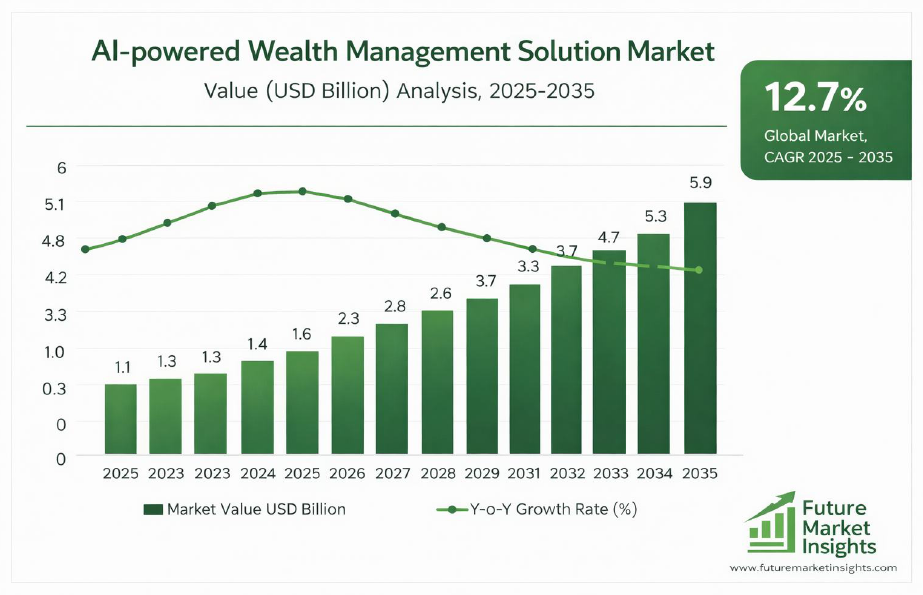
(Source: https://www.futuremarketinsights.com/reports/ai-powered-wealth-management-solution-market)
With explainable AI, human-in-the-loop, and a robust governance framework embedded into the core of an AI-powered client engagement system is prudent for wealth management firms. RIAs and wealth firms must leverage advanced technology with this approach while preserving the foundation of wealth advisory: a relationship built on accountability, trust and professional judgment.
Risk management is an important aspect for the integration of AI-powered client engagement agents in advisor-supportive and client-centric wealth management workflows. For RIAs and wealth firms operating in trust-dependent, highly regulated environments, data security, robust governance frameworks and regulatory alignment are strategic enablers.
The SEC (U.S. Securities and Exchange Commission) and FINRA (Financial Industry Regulatory Authority)are applying technology neutral regulatory framework to Gen AI and agentic AI in wealth management. RIAs and wealth firms face policy scrutiny based mainly on FINRA Rule 3110 for supervisory oversight (reasonable AI with human oversight) and FINRA Rule 2210 for AI communication (fair and balanced).
Client data (portfolio, life events, and tax details, etc.) in wealth management is highly sensitive and demands a strong data foundation and security architecture in an AI-powered client engagement model. A strong data foundation for the integration of an AI-powered client engagement model must have a ‘security-first’ approach, integrating with regulatory standards and strict data protection laws.The AI-powered engagement model should include:
RIAs and wealth firms integrating AI agents into their engagement workflow must consider the AI partner’s data privacy, protection, quality, governance and risk management frameworks to avoid regulatory scrutiny and breach of fiduciary duty.
Formal governance frameworks are critical for the long-term sustainability of AI-powered client engagement models in wealth management, which extend beyond technology or innovation teams. According to Wipro’s report, 62% wealth firms regard a lack of regulatory frameworks and guidelines as a major challenge in AI adoption. 68% of wealth firms are focusing on ethical and regulatory considerations in the integration of AI agents across workflows.10
Robust governance and regulatory frameworks for integration of AI -powered client engagement in wealth management include the following key elements:
Some events in the client’s financial life, such as critical health issues, divorce, etc., require a high degree of empathy. Hence, Human-in-the-loop hybrid AI engagement models should include ethical boundaries that limit system behaviour in sensitive contexts.
Here are the actionable steps to ensure data security and regulatory compliance in AI-powered engagement models:
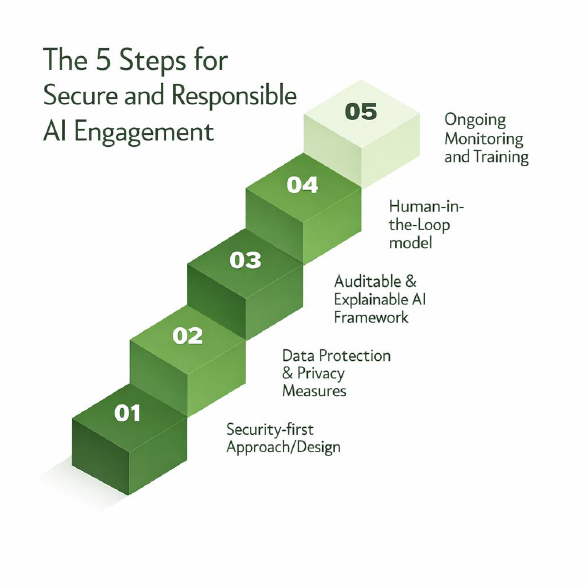
The ability to demonstrate that AI-driven engagement operates within clear fiduciary, legal, and ethical boundaries increasingly shapes regulator confidence, client trust, and long-term scalability.
In wealth management, AI-powered client engagement agents are emerging as core operating models by translating intelligence into improved economics and stronger client relationships. Wealth management companies and firms using AI-powered engagement agents have demonstrated measurable outcomes in terms of engagement activity, client retention, advisor productivity and capacity indicators.
According to industry data, 95% of RIAs using AI have reported four times the adoption rate seen across trusts/banks. 76% of advisors using AI have reported immediate benefit of these tools in their work. Charles Schwab’s 2025 RIA benchmarking study reveals that 95% of RIAs using AI-powered solutions mainly for administration work (43%), marketing (38%), and conducting research (22%) are correlating with higher growth rates.
Real-world Examples: Wipro Wealth AI, a platform that leverages machine learning and predictive analytics for client engagement in wealth management, has reported the following measurable impacts on client engagement, retention and advisor productivity:
Measuring the impact of AI-powered engagement models through a strategic lens is critical for RIAs and wealth firms, as it becomes a core component of workflow design, growth planning, and long-term competitive differentiation.
The future of wealth management is shaped by current structural challenges: clients expecting always-on engagement, highly personalized services, while wealth firms and advisors face mounting regulatory pressure, complexity and operational constraints. Navigating these challenges is not simply a matter of adopting advanced technology-based models; it requires firms to ensure that human expertise, trust and scale coexist within the tech-based hybrid advisory model.
AI-powered client engagement agents in wealth management represent a structural shift in how RIAs and wealth firms deliver advice and service. Responsibly designed engagement models extend the human relationships built on trust, which sit at the heart of fiduciary care. AI-powered engagement agents enable advisors to move beyond a reactive approach to a deeper, proactive approach by liberating them from administrative burden and anchoring them with accurate and actionable insights.
For RIAs and wealth firms, the strategic opportunity lies in embedding an AI-powered client engagement agent across the firm’s value chain. This includes AI integration into workflows, compliance and reporting, and performance measurement, focusing on client-centric growth. Wealth management companies like JPMorgan Chase, Morgan Stanley, BlackRock, etc. and emerging WealthTech players like Wealthfront, Betterment have been reporting tangible outcomes from these resilient AI engagement models.
In this AI-powered engagement model, technology works as an enabler of human connection and not a substitute to human advisor. Advisors play a critical role in trust building, relationship management and decision-making, supported by engagement agents that surface opportunities, reduce friction, and reinforce consistency across the firm.
With shifting client demographics and disrupting traditional models, the ability to deliver transparent, hyper-personalised and scalable engagement will gradually define market leadership. AI-powered engagement, governed with care and guided by fiduciary principles, offers a path to future wealth management, where trust and growth are deeply interconnected.
Uptiq is an AI agent platform purpose-built for wealth management firms. Rather than asking wealth firms to replace the technology they have already invested in, Uptiq deploys a layer of intelligent agents that sit on top of existing core wealth management systems, CRMs, and document infrastructure, doing the work that those systems store and route, but were never designed to think through. Advisors stop rebuilding the same wealth management platform from scratch. RIAs stop chasing documents by email. The systems stay. The manual labour leaves.
What Uptiq does for wealth management firms:
The competitive challenge facing wealth management firms is not a strategy problem. It is a capacity problem. The mission is clear. The membership is loyal. The policies are sound. What constrains growth is the volume of manual work that consumes the team’s time before a single decision is made. Uptiq eliminates that constraint, not by replacing your people, but by removing the work that should never have required them.
A Library of Expert Agents - Rather than a single, monolithic AI platform, Uptiq offers a library of pretrained specialist agents, each one built to master a specific task.
A Crawl, Walk, Run Deployment Model - Uptiq does not ask wealth management firms to solve every problem at once. The deployment model is deliberately incremental: start with the single most painful manual bottleneck, prove the return on investment at that stage, then expand.
Custom Agents for Any Workflow - Through Uptiq’s Agents Unlimited model, the platform designs and deploys AI agents around the credit union’s specific operational challenges, use cases that no off-the-shelf vendor has built a product for.
Live demo using your document types, your loan products, and your credit policy.
See what Uptiq delivers at